 Okay all you Harry Potter fanatics out there. It's survey time. J.K. Rowling says "two major characters will die" in the seventh book. I say it's Harry and Snape. What do you say???
Thursday, March 29, 2007
Survey says...
Okay all you Harry Potter fanatics out there. It's survey time. J.K. Rowling says "two major characters will die" in the seventh book. I say it's Harry and Snape. What do you say???


More TAB reviews!
MS writes:
-- "Bridge to Terabithia" by Katherine Paterson. This book was good and sad. Leslie gave me the great feelings! I thought Jess was okay. He didn't have much of an imagination!
-- "The BFG" by Roald Dahl. This book was a heartwarming story. I LOVE the BFG! He is so cool!
-- "Notes From a Liar and Her Dog" by Gennifer Choldenko. This is a wonderful book. I love having a book that has the main character a liar. It sparks up the book.
-- "Bridge to Terabithia" by Katherine Paterson. This book was good and sad. Leslie gave me the great feelings! I thought Jess was okay. He didn't have much of an imagination!
-- "The BFG" by Roald Dahl. This book was a heartwarming story. I LOVE the BFG! He is so cool!
-- "Notes From a Liar and Her Dog" by Gennifer Choldenko. This is a wonderful book. I love having a book that has the main character a liar. It sparks up the book.
Thursday, March 01, 2007
The Higher Power of Lucky by Susan Patron
 Utterly delightful. Downright charming. A beautiful little book marred by stupid controversy. “The Higher Power of Lucky” came out of nowhere this year to win the most coveted award in children’s literature, the Newbery. A slim volume and tremendously fast read at 133 pages, it is a simple tale richly told. Lucky is a 10½ year old girl living on the edge of the Mojave Desert. Two years earlier, her mother was killed in a freak accident. Lucky, a girl whose innocence and curiosity rings very true, spends the story trying to understand that which is fairly difficult even for adults to comprehend – the nature of life, love and loss. We begin as Lucky listens in on an AA meeting, understanding only that a “Higher Power” is something deeply desirable. She hears much that she doesn’t understand, including the word “scrotum”. And herein lies the controversy. Condemned by school librarians across the country (according to a New York Times article) the book is already being widely banned in a number of school districts. The language is deemed “inappropriate” for young children and “unnecessary to the plot”, some saying that it was placed in the book only for titillation. I couldn’t disagree more. Susan Patron, in the same NY Times article, said the word “scrotum” was “delicious”. As a cursory reading of the opening passages will indicate, the prose here is stunning. To say so much with such economy is a gift among writers, and a book of this quality, IMHO, has not been seen among the Newbery winners in quite a number of years. The “word” ***is*** important, because it shows Lucky’s childlike view of the world. She sees and hears much around her, but hasn’t quite figured out what all the pieces mean. Lucky does what many bright young children do, she attempts to make the unknown fit into her own private reasoning. What doesn’t fit, she creatively makes up stories about. From an adult perspective, there is a sweet nostalgia to her world view. A fond remembrance of the time when our “newness” in the world brought a kind of clarity. Perhaps, under their hysterical harping, this is what all the censors are really concerned about. The protagonist is a child, the book is short, there are even pictures … but it is not a child’s book. The humor is subtle, sly, and at times employs a gentle irony. Would a ten year old “get it” on that level? Probably not. But how many kids would understand and connect to Lucky’s sense of a life that is out of her control? How many kids would know exactly why she takes “a survival bag” with her everywhere so that she will always be safe? As a Newbery Medal winner, this book will be read, and if my gut has anything to say about it, this one is going to be a sentimental favorite for years to come. Take that, you book banners, you. Scrotum, scrotum, scrotum.
Wednesday, February 07, 2007
Tithe by Holly Black
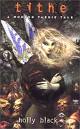
This was my first brush with the newer genre of “Urban Fantasy”. A more contemporary and reality-grounded style hallmarked by authors such as Charles de Lint and Neil Gaiman, I have to say I wasn’t wowed. In the first four chapters, our heroine gets drunk, smokes, is nearly raped, is assaulted by a second man and uses more four letter words than you might hear in the locker rooms of your average sporting event. It takes a full third of the book to get to the fantasy part of this conflicted tale, and that is colored by Dante-like images and Nietzschian philosophy. This novel is dark. Really really dark. Which I wouldn’t mind so much, but there doesn’t seem to be a point. The prose is well written, but the prose doesn’t flow. The copious description that should enhance the reader’s image instead bogs down the storyline, and the storyline itself meanders all over the place until you just want it to be over. A self-described fantasy fan but generally slow reader, I have been known to blaze through novels of this length in a week or less. This one took more than three months, and I can only think that the lengthy read was my resistance to picking it up each time I renewed efforts to finish it. Despite all appearances – a moody fairy gracing the cover, chapter headings with intriguing quotes – I have to believe there is something fundamentally wrong with any book that makes me pick “doing laundry” over “finding out what happens next”. There is obviously a sequel, but I don’t think I’ll be in any rush to read it.
TAB Reviews
LA writes:
-- "The Blue Djinn of Babylon" by P.B. Kerr. This is definitely a worthy sequel to the “Akhenaten Adventure”, explaining the many adventures of two young djinn, John and Philippa. This time, Philippa is kidnapped, and John and his Uncle Nimrod must attempt to find her. But this is not easy – she turns out to be in the palace of the Blue Djinn of Babylon, a famously indifferent djinn who sees Good and Evil as dangerously close to the same thing – and wants Philippa to be her successor! Once again, each of the twins travel across the globe, searching and solving puzzles. This series really makes you think – which I love.
-- "Gregor and the Marks of Secret" by Suzanne Collins. I liked this series a lot at first – particularly the character of Boots, who I find absolutely adorable – but as the series has gotten darker so has my attitude toward it. This particular book is undoubtedly meant to be a World War Two parallel, what with the mice in the gas chambers and the Bone (the rat that Gregor saved in a previous book) sweet-talking them into doing these horrible things. Having read this book at a time when I was in fact studying World War Two in school, this sounded cheesy and clichéd to me immediately. Maybe Suzanne Collins found this “deep” material, but I thought it was sick, disgusting, and just plain dumb. I think that Collins should go back to what she is best at – writing fresh, *original* pieces.
-- "The Wall and the Wing" by Laura Ruby. This book chronicles the story of a girl named, rather obviously, Gurl. She lives in a world where most people – called “Wings” are able to fly, most a few inches above the ground. Gurl can’t – she eventually learns that she is a Wall – she can become invisible. Later, she becomes friends with a boy called Bug, due to his odd facial expression. Gurl finds a kitten – rare for this world – on one of her excursions. But later, the head of the orphanage captures it so that Gurl will steal for her, invisible. Gurl and Bug concoct several plans to change this, and learn several awful truths along the way. Untrustworthy monkeys, an evil, conniving father, a long lost family, a pen with magical properties, and a professor with hair of grass all make an appearance. "The Wall and the Wing" is definitely one of the most original stories I have read in an extremely long time, not to mention full of wonderful writing. This is a fantastic book that anyone could read and enjoy.
-- "Fly by Night" by Frances Hardinge. "Fly by Night" is a terrific book that tells about the venturer of Mosca Mye, a poor girl who changes her life by becoming a servant to the conman Eponymous Clent. In Mosca’s world, people are utterly fearful of an unknown guild of people called the “Birdcatchers” and try to calm themselves by praying to one of their many gods that corresponds with their names. Mosca’s means “the housefly” – therefore she prays to Goodman Palpitattle, a recurring icon in the book. However, Moscda is a suspicious person – throughout the book she spies, watches, and examines countless people and situations. This book is extremely unpredictable, so it keeps the reader curious throughout its entirety. I absolutely loved this book.
-- "Pure Dead Batty" by Debi Gliori. I loved the first two books in the “Pure Dead” series, but by the time “Pure Dead Brilliant” came around, this series had started going downhill. This book chronicles Titus, Pandora, and Damp going on a desperate search for their nanny, Flora MacLachlan. In the previous book, she had gone missing – I was too bored to remember why. Thre are still the usual beasts in this book – and Nestor is enjoyable, as usual, -- but there just isn’t enough material to keep me interested. I hope that someday Debi Gliori writes a better addition to the series – something that *explains* the connections we’ve been seeing in the past three!
-- "Charlie Bone and the Hidden King" by Jenny Nimmo. An absolutely thrilling conclusion to the widespread “Children of the Red King” series, this book’s only fault is the loose ends that weren’t tied up. (However, this does not matter so much to me, because a recent search on Amazon.com shows me a new book about Charlie’s world coming out in a few months!) This being so, the story tells about what happens this time when Charlie Bone returns to Bloor’s Academy for another term. It is discovered that a suspicious tree is really the red kind, disguised, and Charlie need to find a way to release him, because the notorious “Yewbean Aunts” are plotting something … and Charlie needs to know what. Characters are, as always, memorable, and Charlie, as always, succeeds. I absolutely cannot wait for the next book – even if it’s clichéd, even if it’s borderline plagiarism (which I doubt) … this series is wonderful.
-- "Caddy Ever After" by Hilary McKay. I *LOVED* this book sooooo much – this series is completely amazing – unlike anything I have ever read and fantastically BRITISH. In "Caddy Ever After", the story is told from the point of view of each of the four main characters, where their part fits in. In previous books, everything was told from the third person. I think I enjoy Rose’s part the best, because of the original way she thinks and acts – but I also love reading about Saffy – I don’t sympathize with her as much any more, but I still love it – and of course Indigo and Caddy. In this tale, Caddy is getting married, Saffy is cheering up sick best friend Sarah, Indigo is in love, and Rose is just … Rose. Obviously Eve and Bill are there to make everything more complicated, and then there are the matters of Tom and Michael – I can’t explain everyting here – READ THE BOOK!
-- "The Pinhoe Egg" by Diana Wynne Jones. A new installment in Diana Wynne Jones’ excellent “Chrestomanci” series, the Pinhole Egg describes the happenings of Marianne Pinhoe and Cat Chant (a recurring character). Marianne’s grandmother has gone insane, and her family’s spells – all illegal! -- are flying around absolutely everywhere. Marianne gives Cat a large, golden egg and that’s when things start to happen … I love this book, because obviously it’s part of a great series, but also because of the amazing detail involved in it. Diana Wynne Jones allows me to really *see* everything that is going on in the book. When it is over you really feel that you *know* the characters. And of course, it is sad to leave them.
TS writes:
-- "Curse of the Bane" by Joseph Delaney. The second book in the Las Apprentice series. Tom Ward continues his apprenticeship with Gregory the Spook. This time he travels to Priestown where there are, you guessed it, a lot of priests. In Priestown they confront the Bane. Another tale of magic & evil demons, Joseph Delaney give readers a truly spooky book. However, I personally wouldn’t subject this to the faint hearted readers, it is truly frightening.
CK writes:
-- "Rash" by Pete Hautman. Even though this book takes place in the Future (which is cool), Pete Hautman makes the book seem very boring. I didn’t even want to finish the book because it was that boring. 2 thumbs down.
-- "Chasing the Jaguar" by Michele Dominguez Greene. This is an extremely exciting book that keeps you on the edge of your seat. It’s a great mystery book. I also like how the author includes Spanish words which really helped me practice my Spanish and learn new words.
CM writes:
-- "The Wall and the Wing" by Laura Ruby. I thought the plot moved along, and I could relate to the characters.
JV writes:
-- "My Almost Epic Summer" by Adele Griffin. Really funny! Irene has big dreams for starting her own hair salon, but she is always messing up at her mother’s hair salon. When she goes to babysit 2 kids for the summer she meets an extremely pretty girl and a dude from her elementary school. This is a really exciting book that you won’t be able to put down.
-- "The Wright 3" by Blue Balliet. A really good mystery book. Really suspenseful. I advice to read "Chasing Vermeer", the first in the series first.
-- "The Fall of the Amazing Zalindas" by Tracy Mack. This was a very suspenseful mystery book. It was very exciting and a lot easier to understand than the regular Sherlock Holmes books.
-- "You Know You Love Me" by Cecily von Ziegesar. I have read the other ones in the Gossip Girl series and I think that this one was the best. It was kind of suspenseful and really funny.
-- "The Blue Djinn of Babylon" by P.B. Kerr. This is definitely a worthy sequel to the “Akhenaten Adventure”, explaining the many adventures of two young djinn, John and Philippa. This time, Philippa is kidnapped, and John and his Uncle Nimrod must attempt to find her. But this is not easy – she turns out to be in the palace of the Blue Djinn of Babylon, a famously indifferent djinn who sees Good and Evil as dangerously close to the same thing – and wants Philippa to be her successor! Once again, each of the twins travel across the globe, searching and solving puzzles. This series really makes you think – which I love.
-- "Gregor and the Marks of Secret" by Suzanne Collins. I liked this series a lot at first – particularly the character of Boots, who I find absolutely adorable – but as the series has gotten darker so has my attitude toward it. This particular book is undoubtedly meant to be a World War Two parallel, what with the mice in the gas chambers and the Bone (the rat that Gregor saved in a previous book) sweet-talking them into doing these horrible things. Having read this book at a time when I was in fact studying World War Two in school, this sounded cheesy and clichéd to me immediately. Maybe Suzanne Collins found this “deep” material, but I thought it was sick, disgusting, and just plain dumb. I think that Collins should go back to what she is best at – writing fresh, *original* pieces.
-- "The Wall and the Wing" by Laura Ruby. This book chronicles the story of a girl named, rather obviously, Gurl. She lives in a world where most people – called “Wings” are able to fly, most a few inches above the ground. Gurl can’t – she eventually learns that she is a Wall – she can become invisible. Later, she becomes friends with a boy called Bug, due to his odd facial expression. Gurl finds a kitten – rare for this world – on one of her excursions. But later, the head of the orphanage captures it so that Gurl will steal for her, invisible. Gurl and Bug concoct several plans to change this, and learn several awful truths along the way. Untrustworthy monkeys, an evil, conniving father, a long lost family, a pen with magical properties, and a professor with hair of grass all make an appearance. "The Wall and the Wing" is definitely one of the most original stories I have read in an extremely long time, not to mention full of wonderful writing. This is a fantastic book that anyone could read and enjoy.
-- "Fly by Night" by Frances Hardinge. "Fly by Night" is a terrific book that tells about the venturer of Mosca Mye, a poor girl who changes her life by becoming a servant to the conman Eponymous Clent. In Mosca’s world, people are utterly fearful of an unknown guild of people called the “Birdcatchers” and try to calm themselves by praying to one of their many gods that corresponds with their names. Mosca’s means “the housefly” – therefore she prays to Goodman Palpitattle, a recurring icon in the book. However, Moscda is a suspicious person – throughout the book she spies, watches, and examines countless people and situations. This book is extremely unpredictable, so it keeps the reader curious throughout its entirety. I absolutely loved this book.
-- "Pure Dead Batty" by Debi Gliori. I loved the first two books in the “Pure Dead” series, but by the time “Pure Dead Brilliant” came around, this series had started going downhill. This book chronicles Titus, Pandora, and Damp going on a desperate search for their nanny, Flora MacLachlan. In the previous book, she had gone missing – I was too bored to remember why. Thre are still the usual beasts in this book – and Nestor is enjoyable, as usual, -- but there just isn’t enough material to keep me interested. I hope that someday Debi Gliori writes a better addition to the series – something that *explains* the connections we’ve been seeing in the past three!
-- "Charlie Bone and the Hidden King" by Jenny Nimmo. An absolutely thrilling conclusion to the widespread “Children of the Red King” series, this book’s only fault is the loose ends that weren’t tied up. (However, this does not matter so much to me, because a recent search on Amazon.com shows me a new book about Charlie’s world coming out in a few months!) This being so, the story tells about what happens this time when Charlie Bone returns to Bloor’s Academy for another term. It is discovered that a suspicious tree is really the red kind, disguised, and Charlie need to find a way to release him, because the notorious “Yewbean Aunts” are plotting something … and Charlie needs to know what. Characters are, as always, memorable, and Charlie, as always, succeeds. I absolutely cannot wait for the next book – even if it’s clichéd, even if it’s borderline plagiarism (which I doubt) … this series is wonderful.
-- "Caddy Ever After" by Hilary McKay. I *LOVED* this book sooooo much – this series is completely amazing – unlike anything I have ever read and fantastically BRITISH. In "Caddy Ever After", the story is told from the point of view of each of the four main characters, where their part fits in. In previous books, everything was told from the third person. I think I enjoy Rose’s part the best, because of the original way she thinks and acts – but I also love reading about Saffy – I don’t sympathize with her as much any more, but I still love it – and of course Indigo and Caddy. In this tale, Caddy is getting married, Saffy is cheering up sick best friend Sarah, Indigo is in love, and Rose is just … Rose. Obviously Eve and Bill are there to make everything more complicated, and then there are the matters of Tom and Michael – I can’t explain everyting here – READ THE BOOK!
-- "The Pinhoe Egg" by Diana Wynne Jones. A new installment in Diana Wynne Jones’ excellent “Chrestomanci” series, the Pinhole Egg describes the happenings of Marianne Pinhoe and Cat Chant (a recurring character). Marianne’s grandmother has gone insane, and her family’s spells – all illegal! -- are flying around absolutely everywhere. Marianne gives Cat a large, golden egg and that’s when things start to happen … I love this book, because obviously it’s part of a great series, but also because of the amazing detail involved in it. Diana Wynne Jones allows me to really *see* everything that is going on in the book. When it is over you really feel that you *know* the characters. And of course, it is sad to leave them.
TS writes:
-- "Curse of the Bane" by Joseph Delaney. The second book in the Las Apprentice series. Tom Ward continues his apprenticeship with Gregory the Spook. This time he travels to Priestown where there are, you guessed it, a lot of priests. In Priestown they confront the Bane. Another tale of magic & evil demons, Joseph Delaney give readers a truly spooky book. However, I personally wouldn’t subject this to the faint hearted readers, it is truly frightening.
CK writes:
-- "Rash" by Pete Hautman. Even though this book takes place in the Future (which is cool), Pete Hautman makes the book seem very boring. I didn’t even want to finish the book because it was that boring. 2 thumbs down.
-- "Chasing the Jaguar" by Michele Dominguez Greene. This is an extremely exciting book that keeps you on the edge of your seat. It’s a great mystery book. I also like how the author includes Spanish words which really helped me practice my Spanish and learn new words.
CM writes:
-- "The Wall and the Wing" by Laura Ruby. I thought the plot moved along, and I could relate to the characters.
JV writes:
-- "My Almost Epic Summer" by Adele Griffin. Really funny! Irene has big dreams for starting her own hair salon, but she is always messing up at her mother’s hair salon. When she goes to babysit 2 kids for the summer she meets an extremely pretty girl and a dude from her elementary school. This is a really exciting book that you won’t be able to put down.
-- "The Wright 3" by Blue Balliet. A really good mystery book. Really suspenseful. I advice to read "Chasing Vermeer", the first in the series first.
-- "The Fall of the Amazing Zalindas" by Tracy Mack. This was a very suspenseful mystery book. It was very exciting and a lot easier to understand than the regular Sherlock Holmes books.
-- "You Know You Love Me" by Cecily von Ziegesar. I have read the other ones in the Gossip Girl series and I think that this one was the best. It was kind of suspenseful and really funny.
Friday, January 12, 2007
Here's a bunch of reviews from TAB member, LY!
The Palace of Laughter- Jon Berekeley
This book is well written and fast paced, for those of you who hate to read slow moving books. It is about a young boy who tries to enter a circus that seems to pop up overnight. There he meets all kinds of wonders and things that shouldn't exist. When he meets a little girl named Little, he learns that there is something wrong with the circus and what it is. Such as a little man calling himself the Great Cortado *my nickname for him just happens to be Ego-stroker* planning world domination and an assortment of other things.
Fairest-Gail Carson Levine.
This book is kind of like the sequel to Ella Enchanted. It has the same setting and it's in the same time period. One of the characters is also in Ella Enchanted. The only difference is that this girl, unlike Ella, is the supposed daughter of an innkeeper. But her singing voice and the blanket she was found in, proves different. She discovers that she can do all kinds of things with her voice. And eventually someone really important asks for her help. ( Mainly because of her cat)
Changeling- Delia Sherman
A changeling is a human that was switched at birth with a fairy child. This changeling, known as Neef, now lives in the New York Between, where everything magical comes to life. Animals talk, and there are beasts that will hunt you down if you're not careful. Neef, excited about the upcoming Solstice dance, breaks her treaty with the Green Lady of Central Park. In order to regain every right and protection that she had under the treaty back, she must go on a quest for 3 impossible items.
Fire Star- Chris D'Lacey
The third book in the series, another book full of dragons, talking animals, and, of course, one of the best story lines ever. This time, he's got a polar bear on his tail, one trying to steal the gem he holds. He has no idea how to defend himself, but then, think about it. Would you if you were freezing your butt off?
This book is well written and fast paced, for those of you who hate to read slow moving books. It is about a young boy who tries to enter a circus that seems to pop up overnight. There he meets all kinds of wonders and things that shouldn't exist. When he meets a little girl named Little, he learns that there is something wrong with the circus and what it is. Such as a little man calling himself the Great Cortado *my nickname for him just happens to be Ego-stroker* planning world domination and an assortment of other things.
Fairest-Gail Carson Levine.
This book is kind of like the sequel to Ella Enchanted. It has the same setting and it's in the same time period. One of the characters is also in Ella Enchanted. The only difference is that this girl, unlike Ella, is the supposed daughter of an innkeeper. But her singing voice and the blanket she was found in, proves different. She discovers that she can do all kinds of things with her voice. And eventually someone really important asks for her help. ( Mainly because of her cat)
Changeling- Delia Sherman
A changeling is a human that was switched at birth with a fairy child. This changeling, known as Neef, now lives in the New York Between, where everything magical comes to life. Animals talk, and there are beasts that will hunt you down if you're not careful. Neef, excited about the upcoming Solstice dance, breaks her treaty with the Green Lady of Central Park. In order to regain every right and protection that she had under the treaty back, she must go on a quest for 3 impossible items.
Fire Star- Chris D'Lacey
The third book in the series, another book full of dragons, talking animals, and, of course, one of the best story lines ever. This time, he's got a polar bear on his tail, one trying to steal the gem he holds. He has no idea how to defend himself, but then, think about it. Would you if you were freezing your butt off?
Wednesday, December 13, 2006
More TAB reviews!
JV writes:
-- "The Door to Time" by Ulysses Moore. This book was a very exciting thriller. When Jason and Julia move to a big old mansion on a beach from London they go on a twisting mystery starting with a locked door and four animal like keys and ending with a wonderful viking ship. I would give this book a 10 out of 10.
-- "Maximum Ride: School's Out Forever" by James Patterson. THIS BOOK WAS AMAZING!!! This is the 2nd book in the series. I read this book before the first one but WOW! It is a very good story about kids that were experimented on at the "school," (which is a lab) and given wings. The doctors try to find the kids after they escape so that they can do more experiments on them. The kids find out that they were kidnapped away from their parents when they were born, so they go on a long search for their parents but can only find one childs. To find out more Read The Book.
-- "Chasing the Jaguar" by Michele A. Greene. Wow! There was Spanish in the book at some points of the story, but luckily there was a glossary at the end of the book which really helped! The mystery was not as good as the Nancy Drew Books but pretty close.
CM writes:
-- "The Palace of Laughter" by Jon Berkeley. It was neat how the angels came down and that Miles and Little bond. I also think it fits that Miles is an orphan, and I love the tiger!
-- "Gideon, the Cut-Purse" by Linda Buckley-Archer. It has a good story line, and you can see a guy bond with someone from the future whose dad is never there. It's a bit confusing going from past to present, but you understand it as the book goes on.
AW writes:
-- "The Dream-Maker's Magic" by Sharon Shinn. This book is very well written. It talks about this as if you were an adult. Not some little kid that doesn't get anything. There are some hardships that this person had to endure. It's like real life. Not make-believe.
MS writes:
-- "Jumping the Scratch" by Sarah Weeks. This book was fun to read and very good. At the end it didn't leave you hanging. I really enjoyed the main character and I enjoyed the plot.
-- "The Door to Time" by Ulysses Moore. This book was a very exciting thriller. When Jason and Julia move to a big old mansion on a beach from London they go on a twisting mystery starting with a locked door and four animal like keys and ending with a wonderful viking ship. I would give this book a 10 out of 10.
-- "Maximum Ride: School's Out Forever" by James Patterson. THIS BOOK WAS AMAZING!!! This is the 2nd book in the series. I read this book before the first one but WOW! It is a very good story about kids that were experimented on at the "school," (which is a lab) and given wings. The doctors try to find the kids after they escape so that they can do more experiments on them. The kids find out that they were kidnapped away from their parents when they were born, so they go on a long search for their parents but can only find one childs. To find out more Read The Book.
-- "Chasing the Jaguar" by Michele A. Greene. Wow! There was Spanish in the book at some points of the story, but luckily there was a glossary at the end of the book which really helped! The mystery was not as good as the Nancy Drew Books but pretty close.
CM writes:
-- "The Palace of Laughter" by Jon Berkeley. It was neat how the angels came down and that Miles and Little bond. I also think it fits that Miles is an orphan, and I love the tiger!
-- "Gideon, the Cut-Purse" by Linda Buckley-Archer. It has a good story line, and you can see a guy bond with someone from the future whose dad is never there. It's a bit confusing going from past to present, but you understand it as the book goes on.
AW writes:
-- "The Dream-Maker's Magic" by Sharon Shinn. This book is very well written. It talks about this as if you were an adult. Not some little kid that doesn't get anything. There are some hardships that this person had to endure. It's like real life. Not make-believe.
MS writes:
-- "Jumping the Scratch" by Sarah Weeks. This book was fun to read and very good. At the end it didn't leave you hanging. I really enjoyed the main character and I enjoyed the plot.
Tuesday, November 28, 2006
TAB Reviews
The following reviews were written by TAB members.
CK writes:
-- "Amazing Grace" by Megan Shull. It's a wonderful love story that I wouldn't mind reading over and over again.
-- "Being Bindy" by Alyssa Brugman. This book is a wonderful story about how a young girl goes through many hardships and problems and solves them. This book has a great ending.
-- "Dairy Queen: A Novel" by Catherine Gilbert Murdock. This is a wonderful book. I really enjoyed it because at times I can relate to how D.J. feels and some of the characters remind me of people I know.
CM writes:
-- "Specials" by Scott Westerfeld. It had a good ending! It wasn't a cliffhanger like the other books in the series. ***Spoiler alert*** Tally got back together with David! Yeah! She didn't become normal, but it fit the ending so I was happy. :)
-- "Welcome to Wahoo" by Dennis Carr. The writing style was very different and the book kept you guessing. It was an enjoyable book.
-- "Peter and the Shadowthieves" by Dave Barry and Ridley Pearson. The shadow thief was an unexpected turn in the story from the last book. It made you think that evil could win. It was well written, and I enjoyed the story.
-- "The End" by Lemony Snicket. I had been waiting to read this book since the 12th book came out! It revealed something from the Baudelaire's past, but it was a cliff hanger, which I didn't like, but I expected that.
-- "Pretties" by Scott Westerfeld. It was suspenseful, and was eventful, but I didn't like how Tally reacts when she met David. It's ending makes you want to learn more, which I like.
JV writes:
-- "Amazing Grace" by Megan Shull. I liked her style of writing. ***Spoiler alert*** The book was really good and I liked how she sent the money to Fisher.
-- "Peter and the Shadowthieves" by Dave Barry and Ridley Pearson. ***Spoiler alert*** I liked how Peter saves Molly's father.
CK writes:
-- "Amazing Grace" by Megan Shull. It's a wonderful love story that I wouldn't mind reading over and over again.
-- "Being Bindy" by Alyssa Brugman. This book is a wonderful story about how a young girl goes through many hardships and problems and solves them. This book has a great ending.
-- "Dairy Queen: A Novel" by Catherine Gilbert Murdock. This is a wonderful book. I really enjoyed it because at times I can relate to how D.J. feels and some of the characters remind me of people I know.
CM writes:
-- "Specials" by Scott Westerfeld. It had a good ending! It wasn't a cliffhanger like the other books in the series. ***Spoiler alert*** Tally got back together with David! Yeah! She didn't become normal, but it fit the ending so I was happy. :)
-- "Welcome to Wahoo" by Dennis Carr. The writing style was very different and the book kept you guessing. It was an enjoyable book.
-- "Peter and the Shadowthieves" by Dave Barry and Ridley Pearson. The shadow thief was an unexpected turn in the story from the last book. It made you think that evil could win. It was well written, and I enjoyed the story.
-- "The End" by Lemony Snicket. I had been waiting to read this book since the 12th book came out! It revealed something from the Baudelaire's past, but it was a cliff hanger, which I didn't like, but I expected that.
-- "Pretties" by Scott Westerfeld. It was suspenseful, and was eventful, but I didn't like how Tally reacts when she met David. It's ending makes you want to learn more, which I like.
JV writes:
-- "Amazing Grace" by Megan Shull. I liked her style of writing. ***Spoiler alert*** The book was really good and I liked how she sent the money to Fisher.
-- "Peter and the Shadowthieves" by Dave Barry and Ridley Pearson. ***Spoiler alert*** I liked how Peter saves Molly's father.
Monday, October 30, 2006
His Dark Materials series by Phillip Pullman
 Made up of three books (there will be no more in the series), His Dark Materials include: “The Golden Compass”, “The Subtle Knife” and “The Amber Spyglass”. Set in a world as metaphysical as mythical, it is a land seemingly similar to ours. In the first book, a young orphaned girl named Lyra wanders around an “other-Oxford”, discovering deadly secrets about herself and her world. Lyra’s Oxford is a place where bears talk, witches are accepted as normal (if not welcome), and people’s souls are represented by “daemons”, creatures who are with them constantly. In the second book Will, a young boy from our reality, crosses over to Lyra’s world. In the third book, Lyra and Will join forces to a very dark end. The books took me a very long time to get into, but again, I had students who insisted I “had” to read them, so I stuck with it. The level of description is high, almost like Dickens, and the world Lyra inhabits is one of great complexity and many levels. Pullman pulls no punches in these books, and without revealing too much, I urge readers not to get too connected to *any* character in the series. All three books had a sad quality I don’t personally care for, but a tone that fit perfectly with the story that needed to be told. Both the first and second novels end with gasping cliff-hangars, so make sure to have the next volume ready. I warmed up more and more with each book, mostly as I began to “get” what the author was after. Interestingly enough, most students who read the series tell me they like the first book the best and successive books less well. I often compare the series to Harry Potter, saying it is like “J.K Rowling translated by Jeopardy winners”. It becomes much less Harry Potter after the first novel, with Pullman’s real agenda becoming more and more apparent. Phillip Pullman, the son of a Lutheran minister, raised on the Christian allegories in the works of C.S. Lewis and J.R.R. Tolkien, became a fairly angry atheist. Determined to write the “anti-Christian” young adult novels, he succeeds fairly brilliantly with this elongated tale, and I have to say I found humor in his twisting of the traditional metaphors to bring in his alternate belief system. By the third book, his attack against traditionalism becomes quite clear (I don’t want to offer details and give it away). I would recommend that you be “open” to a variety of religious interpretations before tackling it. Needless to say, this series has been utterly demonized by the extreme Christian fundamentalists, and I can honestly say (for once in my life) that I see their point, even if I don’t necessarily agree with it. But we live in America, a land based in part on religious pluralism and dedicated to free speech. Pullman has written a powerful and intense series with great literary merit. Young people can, and should, read his work and decide for themselves whether their experiences line up with those in the story.
The House of the Scorpion by Nancy Farmer
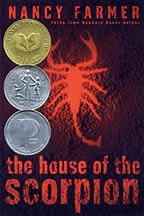 I read this because one of my 7th grade students told me I “simply had to”. He proclaimed it the “best book” he had ever read. After reading Nancy Farmer’s Newbery Honor title “A Girl Named Disaster” I was hesitant to delve into another Farmer book. I found “A Girl Named Disaster” to be overly long, interesting but not engaging. Nevertheless, when a student proclaims I “must” read something (which is how I discovered Phillip Pullman), I tend to listen. I dove in and was immediately floored. The subject matter and story are dense, the concepts both scary and intriguing. That 7th grade student was one smart cookie! “The House of the Scorpion” takes place in the near future, when a “drug zone” nation has been set up between the United States and Mexico (now named “Aztlan”). The deal is, they let the drug lords have their own country to grow whatever they wish, and the drug lords agree not to sell it to either of the bordering nations. That, however, is not the main story. This is a time when cloning and medical manipulations are commonplace. “Modified” humans are used as slaves to farm the fields and clones are used as body parts to keep one of the most powerful of the drug lords, Matteo Alacran, alive long past the time of a natural death. Alacran, like most drug lords, is both dangerous and egotistical. When it becomes clear that not even the cloned body parts can keep him alive, he orders the production of a new clone, “Matt” who is both son and mirror image, and is possibly the person replace him if he eventually dies. The book is Matt’s story, literally from inception, and the awareness he has of his own “personhood” is challenged throughout. The ending is somewhat open, not unlike Lowry’s “The Giver”, but this tale will stay with you for a good long time. Deeply disturbing and brilliant on many levels, this book has won oodles of awards – the Printz Award, the National Book Award, the Newbery Honor – all quite justified. My student was right. Although long and painful at times, you simply MUST read this one.
Thief by Megan Whalen Turner
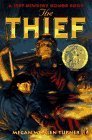 Ms. Turner is part of that group of young adult authors who showed up a few years back and really energized books for teens. This is an action-packed fantasy about cocky thief, Gen, who ends up over his head when caught between the warring royalty of two provinces in a mystical land. Ms. Turner manages to get the moral across without being the least bit preachy and also manages to throw in a good number of twists and surprises along the way. The action is a tad more violent than you might expect, but the goriest of details are left to the imagination, and overall the tone is one of talking *to* the reader, not *down* to them. My one complaint is that this book has a slow start. I found I had to push myself a good 40 pages or so into it before it hooked me…but then it really hooked me. Refreshing to see a story where you can’t predict what will happen next. I also like the mystery aspect. It is truly hard at some points to figure out who is good and who is not. The book ends with quite a cliffhanger. “The Queen of Attolia” is the sequel and well worth the read. There has been another book out in the series for a while now, “The King of Attolia” which I haven’t had a chance to read. It, like everything else, will have to “go on the list”.
Squashed by Joan Bauer
 Joan Bauer is one of those authors that manages to write fairly low action stories that are completely engaging. When you tell the plot of “Squashed” it sounds a little silly. Ellie, a 16 year-old girl struggling with her weight and school life, tries yet again to beat her evil neighbor at the annual pumpkin contest (to grow the largest pumpkin). What becomes clear, however, is that Ellie is a real, funny, complex and very human character that is easy to connect to. As a reader, you start rooting for her. As an older reader, it was easy to see how the obsessive focus on pumpkins helped fill the void left by her mother’s death. This is not a sad book, though. It has charm and sensitivity, and just a touch of romance. It is life through orange colored glasses (sorry, couldn’t resist). A warm-hearted tale for crispy fall weather, it’s a fast read that will put a smile on your face. If you want an outright guffaw, check out “Thwonk!” by the same author. In this story, a similarly strong-willed girl meets the cupid from heck.
Understanding Comics: The Invisible Art by Scott McCloud
 LOVED IT. This is the most amazing graphic novel…about graphic novels. It’s basically a step by step guide to everything graphic. Scott takes extremely high level concepts (art history, the psychology of self awareness, the nature of communication and symbolism) and explains them all, in a reasonable progression with no dumbing down of the topic. When you finish reading his narrative, you feel like you’ve just finished a college level course on the subject. He has terrific images, using examples for the difference in styles, and a wry sense of humor throughout. I honestly can’t remember ever reading such dense material and enjoying it so thoroughly. There are numerous opportunities for discussions and theory beyond what is presented. I really think this is a book that could be used in the classroom, and very much liked.
Montmorency: Thief, Liar, Gentleman? by Eleanor Updale
 Honestly, this one took me a while to get into. Advertised as a mystery, it begins in a Phillip Pullman-like England…in an uncertain time of the past where there is a degree of the fantastical makes you wonder if we are talking about reality or science fiction. Montmorency, a thief, is rescued (temporarily) from his horrific jail cell by a doctor with some unorthodox methods. While on the outside, he learns secrets that he later uses, upon his release, to steal. From there, things get a tad complicated! I began to connect with the book when I saw the humanity dawning in Montmorency. He begins as a deeply unsympathetic character, but he grows. This book is densely woven. It is a mystery, as well as an adventure tale and historical novel, but it is also the story of redemption, and one that is very slowly plotted. Montmorency will always have a thief inside, but he becomes “The Gentleman” in ways he never expected. As the reader, I appreciated his realistic struggle to bring into balance his differing personas. There are now three sequels I have not read, but based on this book, I look forward to them.
Crispin (the Cross of Lead) by Avi
 This is another one of those Newbery Winners (2003) that most kids don’t warm up to. I understand to a degree. It took me a while to get into the book – I couldn’t figure out what it wanted to be. Elements of mystery, adventure, historical realism even humor wind through the narrative from chapter to chapter. That’s typical of Avi, the virtual chameleon of young adult writers, and once I just accepted it at face value I was pulled in. The story focuses on “Asta’s son”, a poor boy who must flee his village after his stepmother dies and he is accused of a crime he did not commit. There are secrets about the boy’s existence (not the least of which is “Crispin” which he learns is his name), hinted at but not solved in this novel (there has since been a sequel I have not read). I think I began to enjoy this story when the newly dubbed Crispin meets Bear – a juggler and possible thief whose philosophy of life is enjoyable and warm. The book is good, but again, not the kind of “great” that I expect of a Newbery. I preferred Avi’s “The Man Who Was Poe” and “Nothing But the Truth” to this novel, but I haven’t quite figured out the distaste for it that many students have, unless it is just too similar to history class subjects. Comments?
Ruby Holler by Sharon Creech
 This book had me from the opening words. It is lyric and downright charming – a splendid addition to a body of work from the “next generation” of really good young adult authors. Sharon Creech won the Newbery with “Walk Two Moons” and that quiet and gentle novel was hugely popular, something that doesn’t typically happen with character driven stories and teens. But Ms. Creech is good…really good. Her descriptive passages are lush and often downright funny. In “Ruby Holler” her style was so engaging that I began to use passages of the book as examples with my creative writing students. The story is that of Dallas and Florida, a brother and sister who have moved from foster home to foster home, encountering rotten guardians along the way. When they finally land with a sweet elderly couple things look like they are going to work out, but I guarantee the action is real and touching, not sappy and overly sweet. Like “The Great Gilly Hopkins” for older students, and more upbeat than the Baudelaire struggles, this tale hits the perfect middle note in plethora of abandoned children sagas. Ms. Creech continues to pump them out, and I haven’t heard a negative review yet. I look forward to her ongoing efforts.
The Giver by Lois Lowry
 “The Giver” is one of those “guarantee” books. I can give it to almost any kid and they will like it. I think I’ve only had two kids ever tell me they didn’t like it since it first arrived. To this day, it remains one of my favorites. The Newbery winner for 1994, this fairly sci-fi novel stunned me with its broad appeal. The reason for its universality, however, is clearly the outstanding writing and the surprising twists and turns. The book has fresh ideas and approaches even everyday activities from a different angle. Jonas, a young boy in a very authoritative world (seemingly post-apocalyptic), is awarded the unique role of becoming his community’s next “Giver”. The Giver is a wise soul who holds the memories of the people. It is in these memories that Jonas begins to struggle against the controlling yoke of his world. Without ruining too many surprises, he sees things he didn’t even realize were missing – as readers you may be surprised as well. The ending has a bit of controversy, and although the author has since stated “what really happens” it is still open-ended. The book can be taken on face value but also has tremendous symbolism and can therefore be appreciated by both the young and old. I haven’t read “Gathering Blue” or “The Messenger”, said to be companion novels rather than sequels, but word has it they are worth the time.
Friday, October 13, 2006
Catherine, Called Birdy by Karen Cushman
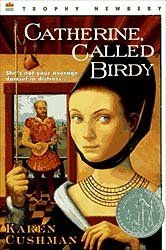 With one of the best openings of a middle school novel, this diary-style historical fiction book is a joy to read. For me, the best part is the lead character, Birdy, who has a strong and engaging voice, one that pulls you in and makes you feel as if you have found a new best friend. The description of the period (a noblewoman in the late 1290s) is dead on, and readers are likely to have a strong sense of the period after reading it without feeling like they have been “taught” the information. I liked this book a tad better than Cushman’s other historical piece, “Midwife’s Apprentice” solely because the protagonist is so enjoyable. She does have a good deal of “beyond the period” feminist sensibilities, which I generally do not like, but the book as a whole is written so well I honestly didn’t mind it. Thoroughly enjoyable.
Pedro and Me by Judd Winick
 As mentioned in earlier reviews, I sometimes struggle with graphic novels. Although a child of the TV generation, I never learned to multitask quite as well as today’s youth, and my ability to track both images and words in a story is limited (don’t get me started on my strong distaste for subtitled films). And yet. Every once in a while you come across a graphic novel so good, you forget it is a graphic novel and just “read” it. This is one of those books. Judd Winick was on an MTV program called “Real World”, where young people were placed together in apartments around the world and forced to live with each other’s eccentricities all in the light of a constant set of cameras set to record their every argument and tryst. In Judd’s case, there was a twist. He was a fairly unassuming young cartoonist who was given a flamboyant young Cuban man, Pedro Zamora, as a roommate. Pedro had AIDS. Judd chronicles his experience confronting his own fears and his learning curve about the disease in this powerful nonfiction graphic novel. Judd and Pedro became friends, and Judd took on the very public fight to educate people about HIV when Pedro could not carry on. For a cartoonist, the prose is excellent. I think this is because Judd speaks honestly and openly. There isn’t any effort at “pretty literary technique” here, it’s just a real person, talking in depth about a very real event (which is not to say that it isn’t smart…he quotes John Irving at one point). This isn’t one of those “touching” books, it’s one of those “rip out your heart” books. Even thinking about it today makes me feel very weepy, but I truly believe it is one of the most powerful and intelligent books I have ever read. I don’t just recommend it, I think it should be a required read in every high school in America. Just don’t forget the Kleenex. Or your outrage.
Holes by Louis Sachar
 This is one I call a “good Newbery”. Winning the award in 1999, “Holes” has quickly become one of the modern classics. Sachar weaves a clever, funny, touching and unexpected tale of Stanley Yelnats, a boy who was simply born to be a loser. Arrested for a crime he did not commit, he is found guilty and sent to the desert to dig holes. While his body undergoes dramatic changes, his outlook on the world changes as well. He discovers he is cursed, and a parallel story of the past begins to unfold in alternate chapters. Sachar is smart. His dialog makes you think, then smile, as you realize how he “grows” the different elements of his story. The twists come rapidly throughout the book, and I didn’t see a one of them coming – and with all the books I read, I love a “fresh” story. There were bellylaughs combined with deep sighs of frustration at the lot Stanley has been given. It is a rare and gifted author who can twist your heart from one extreme to the other over and over in a short period of time. Bravo to Mr. Sachar, may generations of kids enjoy this story in the years to come!
Subscribe to:
Posts (Atom)